The method and reason behind the madness...

The selections: Mainly, I have chosen books that were recommended during my "Transacting with Literature" class taught by Dr. Wooten at the University of TN. Some of these books were recommended by Dr. Wooten and some were introduced to me by my fabulous classmates. Additionally, some of the books were added to my database because I just love the book. Many of my entries are formatted in the annotated bibliography format in order to meet the requirements for the aforementioned class. However, many of my entries were made and labeled purely for my own convenience. How this page works: You can search by searching keywords in the top left hand corner of the page. You type in words that might relate to something you are studying or reading about and the blog will spit out the books that are labeled with those keywords. For example, WWII, give it a try. Also, you can click on the labels on the right hand side of the page or the bottom of each blog to find similar or related books. My goal: I hope to be able to add to this electronic database every time a friend recommends a book. Eventually, I would love to be able to type a key word into my search and pull a list of books to meet my needs. My request: If you are visiting this site and you can think of some books I must read, please send me an email and let me know. I'll create an entry for the book and label it appropriately to work with my other entries.
Showing posts with label Historical Fiction. Show all posts

My Brother Sam is Dead


The following review was taken from THIS site:
My Brother Sam is Dead tells the story of the Revolutionary war through the eyes of Tim Meeker, a young boy whose brother Sam has left the Yale and his family to fight with the Rebels. Tim can't decide if he's a Tory (sympathizer with the British) or wants to see America a free country. Ultimately the decision doesn't matter as life gets more difficult and the war continues on.

Growing up American, everything I've ever heard about the Revolutionary War has been through the eyes of brave, strong Patriots who fought tooth and limb for our freedom. This book has helped me see there is a whole other side to the story. There were towns of colonists who were just fine under British rule and didn't see a need for independence. Yet they had to make sacrifices too, for a country they didn't even believe in. I've always seen Tories as unpatriotic ignorant old people whose love for the Mother Country would never die. My opinion of them have changed as a result of this book. I think every student studying U.S. history should read this book. It will help them gain a deeper appreciation for their freedom, it will help them see there are two sides to every story, and hopefully it will help them see that war is not the best solution to a problem.

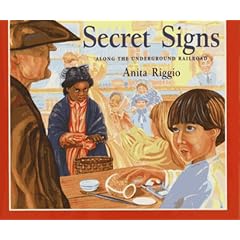
Secret Signs; Along the Underground Railroad


Riggio, Anita, (2002) Secret Signs; Along the Underground Railroad. Boyds Mills Press.

*Sign Language
*Slavery
*Underground Railroad

Out of the Dust


Hesse, Karen. (1999) Out of the Dust. Scholastic.


Here is a great middle school wiki all about the great depression with reference to Out of the Dust

Orphan Train


Kay, Verla. (2003)Orphan Train. Illustrated by Ken Stark. Putnam Juvenile.
Visit THIS SITE for more information about the author Verla Kay

Fever 1793


Anderson, Laurie. (2002) Fever 1793. Simon & Schuster Publishing


From Publishers WeeklyThe opening scene of Anderson's ambitious novel about the yellow fever epidemic that ravaged Philadelphia in the late 18th century shows a hint of the gallows humor and insight of her previous novel, Speak. Sixteen-year-old Matilda "Mattie" Cook awakens in the sweltering summer heat on August 16th, 1793, to her mother's command to rouse and with a mosquito buzzing in her ear. She shoos her cat from her mother's favorite quilt and thinks to herself, "I had just saved her precious quilt from disaster, but would she appreciate it? Of course not." Mattie's wit again shines through several chapters later during a visit to her wealthy neighbors' house, the Ogilvies. Having refused to let their serving girl, Eliza, coif her for the occasion, Mattie regrets it as soon as she lays eyes on the Ogilvie sisters, who wear matching bombazine gowns, curly hair piled high on their heads ("I should have let Eliza curl my hair. Dash it all"). But thereafter, Mattie's character development, as well as those of her grandfather and widowed mother, takes a back seat to the historical details of Philadelphia and environs. Extremely well researched, Anderson's novel paints a vivid picture of the seedy waterfront, the devastation the disease wreaks on a once thriving city, and the bitterness of neighbor toward neighbor as those suspected of infection are physically cast aside. However, these larger scale views take precedence over the kind of intimate scenes that Anderson crafted so masterfully in Speak. Scenes of historical significance, such as George Washington returning to Philadelphia, then the nation's capital, to signify the end of the epidemic are delivered with more impact than scenes of great personal significance to Mattie. Ages 10-14. (Sept.) Copyright 2000 Reed Business Information, Inc. --This text refers to the Hardcover edition.

Rhyolite

Twenty One Elephants and Still Standing


Prince, April. (2005) Twenty One Elephants and Still Standing. Illustrated by Francois Roca. Houghton Mifflin.

*Brooklyn Bridge
*Elephants
*Circus
*Bridges


For another splendid version of this tale, check out Twenty-One Elephants (2004)

A Big Cheese for the White House


Fleming, Candace. (2004) A Big Cheese for the White House; A True Tale of a Tremendous Cheddar. Illustrated by S.D. Schindler. Farrar, Straus and Giroux.

Rose Blanche


Innocenti, Roberto (1985). Rose Blanche. Mankato, MN. Creative Education.

Excerpt from THIS NY Times Review:
ROSE BLANCHE By Christophe Gallaz and Roberto Innocenti. Illustrated by Roberto Innocenti. Translated by Martha Coventry and Richard Graglia. Illustrated. Unpaged. Mankato, Minn.: Creative Education. $14.95. (Ages 8 and up) IT is our duty to tell children some terrible truths. If the telling causes horror and sorrow, these are appropriate emotions for certain recent historical events, and it is necessary for the young to suffer this painful learning if the future is not to repeat the worst mistakes of the past. But we must be careful to do the telling right.

Old Penn Station


Low, William

A Single Shard


Park, Linda Sue. (2003) A Single Shard. Yearling.

There is a great review of this book HERE!


Erika's Story


Vander Zee, Ruth. (2003) Erika's Story. Illustrated by Roberto Innocenti. Creative Editions.


From School Library Journal:
Grade 3 Up-Vander Zee narrates this true story in the voice of Erika, a woman she encountered in a German village, who, as a blanket-wrapped infant, was thrown from a cattle car bound for a concentration camp in 1944. ("On her way to death, my mother threw me to life.") A German woman risked her own life to raise Erika, who eventually married and had children of her own. ("Today my tree once again has roots.") The spare, eloquent text perfectly complements Innocenti's gray and beige photo-realistic illustrations that show haunting, finely detailed, sterile winter scenes of train cars, tracks, and cold brick-and-stone buildings surrounded by barbed wire. On other pages, a white baby carriage and the small pink bundle catch the eye. Only the contemporary opening scene and the final postwar spread are in full color. Compelling and powerful in its simplicity, Erika's story proves that determination, hope, and goodness can overcome evil. Stars are important to this story. Yellow Stars of David are visible on the people's clothing and the symbol appears on every page, separating Erika's thoughts. She mentions God's biblical promise to Abraham that his people "would be as many as the stars in the heavens," and that "six million of those stars fell between 1933 and 1945." The large die-cut yellow pentagram on the front cover is a jarring exception to the carefully crafted text and illustrations. This poignant story of survival deserves a wide audience.Susan Scheps, Shaker Heights Public Library, OH

Snowflake Bentley


Martin, Jacqueline. (1998) Snowflake Bentley. Illustrated by Mary Azarian. NY. Houghton Mifflin for Children.

Amazon.com Review
Most children are captivated by snow, but how many go on to make it their lifework? This beautiful biography, winner of the 1999 Caldecott Medal, tells the true story of a Vermont farm boy who was mesmerized by snowflakes. Wilson Bentley was fascinated by the six-sided frozen phenomena, and once he acquired a microscope with a camera, his childhood preoccupation took on a more scientific leaning. Bentley spent his life taking countless exquisite photographs (many that are still used in nature photography today), examining the tiny crystals and their delicate, mathematical structures. Jacqueline Briggs Martin tells this tale with simple, graceful prose that will engage children's imaginations. Edifying and snowflake-scattered sidebars offer more information about Bentley's methods and snowflake science. The artwork of Mary Azarian, whose 19th-century hand-press illustrations decorate the charming Barn Cat, shines once again in Snowflake Bentley, with woodcuts that reveal an appreciation for detail as well as for the man who loved snow. The lovely illustrations and equally fresh text will inspire and comfort youngsters (and grownups too) who wish they could capture snowflakes all year long. (Ages 4 to 8) --Brangien Davis


Click HERE to visit the Wilson Bentley site.

Molly Bannaky


Mcgill, Alice. (1999) Molly Bannaky. New York. Houghton Mifflin Books


Related books at the local library
Purchase this book

*Mrs. Feagins' has not read this book

* Dr. Wooten recommends this book

A Woman for President: The Story of Victoria Woodhull


Krull, Kathleen. (2006). A Woman for President. Illustrated by Jane Dyer. Walker Books for Young Readers.


From Booklist
Victoria Woodhull's life reads like a novel. A Dickensian childhood led to a teenage career as a spiritualist. Later, her perceived ability to talk to mediums influenced Cornelius Vanderbilt to take her stock-market advice--and give her millions of dollars. Rich enough to advance her political ideas about equality for women, she started her own newspaper and investment business and eventually ran for president against Grant. Woodhull is a fascinating figure, and Krull's lively and astute writing does her justice (though she leaves out that messy business of Woodhull's promotion of free love). Krull also gives kids a clear picture of the fettered life of most women of the time, clearly contrasting it with the stances taken by Woodhull and other suffragettes. Dyer tends toward portraiture here, and at times, Woodhull seems surprisingly placid in the art, but the watercolors, cast with a golden glow, are handsome and add a dignified note to the occasionally raucous events. Ilene Cooper
Copyright © American Library Association. All rights reserved --This text refers to the Hardcover edition.